
Review: Isles of the Emberdark, by Brandon Sanderson
by

Stuart Holland
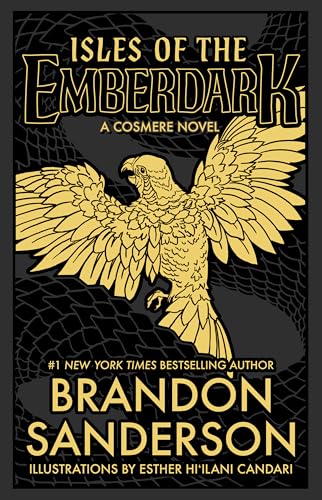
Another Sanderson Secret Project! The man is a writing machine. I’m actually going to start this review off by talking about the physical object that is the book itself! Like the other Secret Projects (Tress of the Emerald Sea and friends), the cover is beautiful. Foiled artwork with complex patterns and textures all over it. It also has several beautiful pieces of art embedded within the book that depict scenes that are nearby in the narrative - some single page and a couple that are a full spread of two pages.
Those are amazing but they’re also a similar premium experience the Kickstarter editions of the other Secret Projects had. This time, part way through the book, the entire printing gets turned on its head: white text on black instead of the black on white it had been before. The entire book goes into dark mode and it’s very evocative. I’m a “light mode” user of computer software where there’s an option, so dark mode isn’t something I’m craving in physical books, but I do very much appreciate the experimenting with the physicality of the product as well!
On to the story! I think Isles of the Emberdark is the best of the Secret Projects sub-series, which is a high bar since I did enjoy Sunlit Man, Yumi and the Nightmare Painter, and Tress of the Emerald Sea so much! As Brandon mentions in the foreword, Emberdark has one of his previous short stories woven into it as a flashback (Sixth of the Dusk). I had read that short story before, but a long time ago, so it was worth rereading inline (and it was short enough anyway, and only in part 1 of this book).
My my I loved this book. The glimpses of future cosmere are becoming clearer and clearer. A lot of the story for Dusk (the character) is from the perspective of not understanding the wider universe, but he’s a perceptive man and deals with it well. Readers, who exist outside the continuity with all of our previous knowledge, can fill in a lot about a . Starling, the other primary point of view character, was absolutely delightful. Her purposeful optimism in the face of adversity and despair is something I particularly admire, in people both real and fictional.
Starling’s point of view is also significantly more informed about the goings on of the wider cosmere, which is particularly fun for lore nerding about the Sanderson universe. Any time I read online about these books, I find whole entire new layers that I’d been totally unaware of, even though I’d seen many connections beyond the individual story already.
That’s not to say that this individual book doesn’t have a significant standalone story of its own: it does and it needs to in order to be an effective vehicle for the cosmere along the way. Dusk’s journey about being a man who technology and culture have left behind is a very interesting one. He embraces the good and bad of that, grumpily but pragmatically. I can see how that kind of question: “Am I still relevant?”, “Is society changing in a way that makes it worse?” connects to our reality about generative AI and what it means for authorship. (And I call out that tech because today it’s the one being disruptive - it would’ve been the internet 30 years ago, at some previous time it was electricity, for Dusk and for humanity in the past, it was steam power).
Back to Starling though, it’s very interesting for me that Dragonsteel Prime is non-canon. A lot of passing references from her perspective connect to things I saw in Dragonsteel Prime. That means the events of Dragonsteel Prime didn’t happen in the cosmere, but clearly Sanderson is using them as a kind of reference and some version of those events happened in the Cosmere. There’s a Frost (who is Starling’s uncle and an ancient dragon), there are Sho Del, there are tamukeks, there’s a planet Yolen (which we have heard referenced before, I think), and many others.
I enjoyed Sunlit Man’s connections to the cosmere, but they were oblique. Emberdark is much more direct and I love seeing a glimpse of what’s coming up next, in whichever big series ends up set in this time period.
Overall, Isles of the Emberdark is fantastic. You can enjoy it as its own story, about progress and culture and stories and what they mean to people. About how one finds their place in a world that is continuing to move forward. And you’ll get the most out of this book if you’ve read the rest of the cosmere.