Review: At the Mountains of Madness and Other Stories, By H.P. Lovecraft
by

Stuart Holland
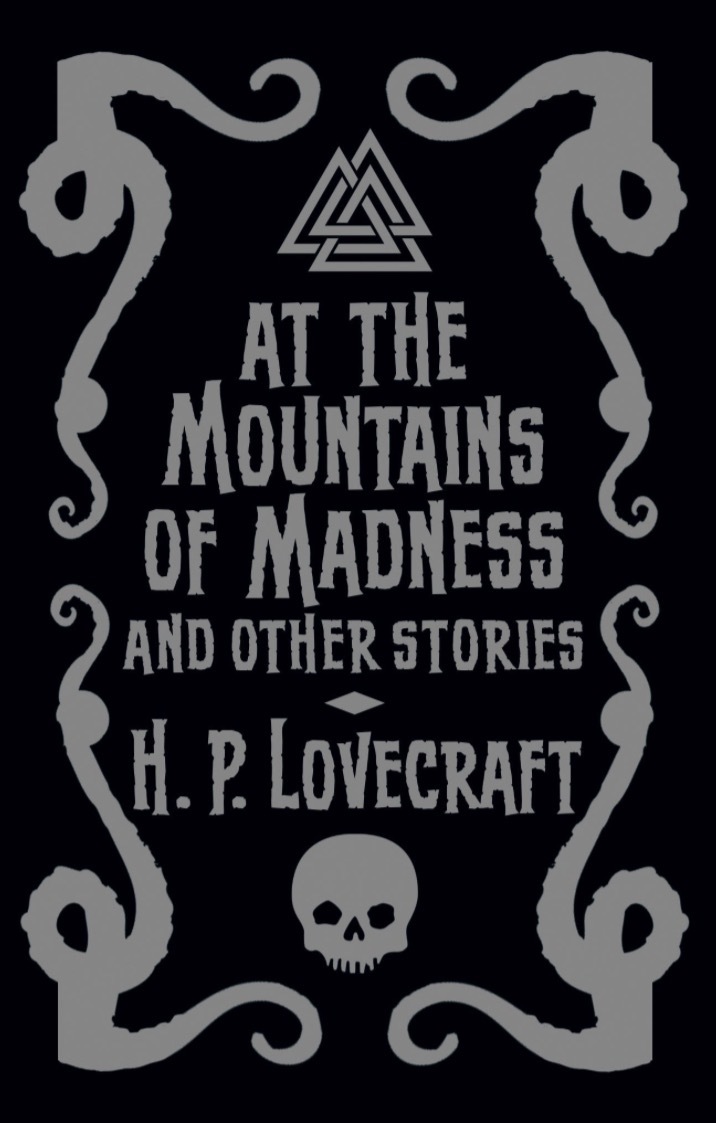
This short story collection contains 3 of Lovecraft’s stories: At the Mountains of Madness, The Shadow over Innsmouth, and The Thing on the Doorstep. In each of them, cosmic horror comes to visit and drives its protagonists and characters quite mad. When I read the previous collection in this series, Stories of the Dreamlands, I got bogged down with it feeling quite slow. That was much less the case this time! Though I’m not sure whether that’s more about the book or me.
The first story, and the one the book takes its title from, is remarkable in how little actually happens. And that’s not necessarily a problem, the draw for a story like this is in the prose and the how of the happenings in the book. In short,
That’s everything that happens, but it’s the way it happens that’s captivating. The way that the cavernous rooms within the city are given an otherworldly aura that feeds on the sanity of the observer. The way the dogs’ disquiet foreshadows the evil that is coming. The way the great many-limbed fossils are too well preserved.
The second story is still supernatural but is also much more normal in a way. Innsmouth is a (fictional) small town in the USA, not a remote corner of the antarctic. But horrors still emerge from the sea, and they mostly take a more creeping, insidious hold over the peoples of the town. As the protagonist slowly discovers, it isn’t just an acutely dangerous monster that he needs to deal with (and by the end ) but also the slow takeover . In even turns out that, unwittingly, .
The final story, when read after the previous two, gives a great sense of a connected universe. There’s an offhand remark of someone with the last name Sargent from Innsmouth in The Thing on the Doorstep, who must be related to the Joe Sargent who drives the bus in The Shadow Over Innsmouth.
In all of these stories, the draw is the way that Lovecraft’s writing wanders in the mounting madness. The creeping dread and the otherworldly distortions of perception aren’t only in the world of the book, they’re also in the twisting and turning of sentences, which forces the reader to twist and turn with them. Even things that aren’t themselves directly frightening, take on a pallid, warped aspect when Lovecraft takes the time to shew you how, despite the character’s understanding, something else in the musical piping and guttural wailing inspires an amorphous fear of entities beyond understanding.
Despite clearly being horror, it’s interesting that I don’t find it particularly scary in a personal sense. I’m not hearing things go bump in the night after reading, which I do after other horror subgenre experiences. That’s a pleasant change for me.