
Review: The Broken Eye, by Brent Weeks
by

Stuart Holland
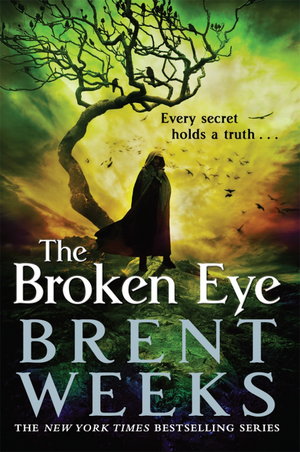
I read the previous book in this series, The Blinding Knife, back in 2016, so it has been a while since I’ve visited this world. I’m aiming to read a few books this year to get back to my real long-tome epic fantasy book roots, with someone aside from Brandon Sanderson. I can see from my stats that I’ve trended toward shorter books in the past few years, so here’s a little of going the other way.
According to my own previous ratings, I very much enjoyed the first book in the Lightbringer series (The Black Prism, which I gave 5 stars), but did not nearly as much enjoy The Blinding Knife (3 stars). A long time has passed since 2016 though, and this seemed like a good long read to return to. I didn’t reread the previous books, because that’s not what I do, so I’m very impressed by how much sense this book still made to me. I’m also impressed that as I started and we picked up with Gavin as a galley slave on Gunner’s ship, I actually did remember that that had happened at the end of book 2.
Brent Weeks has an interesting writing style that occasionally dips into the direct thoughts of the point of view character without any of the usual typesetting information that would accompany that. (No thoughts in italics or quotation marked with “she thought” or any similar device.) It means that sometimes you realize you’re getting a direct line into the character’s head, not just one influenced by them, but only after you’ve read part of it. It works well and gives the different point of view characters a lot of flavor.
In epic fantasy style, this book has a big cast, and a large world wrapped in intrigue that branches off in a bunch of directions. It does a great job of pulling characters in unexpected directions without feeling disjointed. Characters have agency, but they also suffer consequences, and there is always something exciting happening for the entire 800+ page duration, which is a difficult trick unto itself.
I like Kip, he’s a fun primary protagonist and combines an unusual set of personal hangups. I remember him being overweight in the previous books, but his training has changed that by the third book, but his mind hasn’t caught up with it yet. And his relationship to Andross is an interesting one. Andross plays the primary antagonist in this book, despite that you’d expect that role to go to the Color Prince, who instead exists largely outside the story that’s happening for most of the book. The Color Prince is more like a force of nature for the moment, an encroaching, larger context problem that is set to upset everything the characters are trying to do in their own worlds. The balance between how much we see of both of those worlds is a good one, keeping the Color Prince threatening and relevant, but still letting the main narrative stretch its own legs.
Teia’s arc throughout this book didn’t go where I thought it would, and she ends up being the closest to the . Karris also goes through a lot but generally handles it very well.
There is an element of tragedy to many of the characters’ relationships, and we see that through Brent Weeks’s style, how their thoughts and actions don’t always line up because circumstances don’t let them tell someone what they need to hear. This can feel very forced in a lot of books, but Weeks does a great job of realistically preventing the “sit down and talk about it” resolution that is normally frustratingly absent. I believe that the occasions where that would’ve solved the characters’ problems were genuinely obstructed by circumstance, instead of just narrative convenience.
Overall, I’ll keep going with this series again, after a long hiatus. On to The Blood Mirror.