
Four Seasons in Japan, by Nick Bradley
by

Stuart Holland
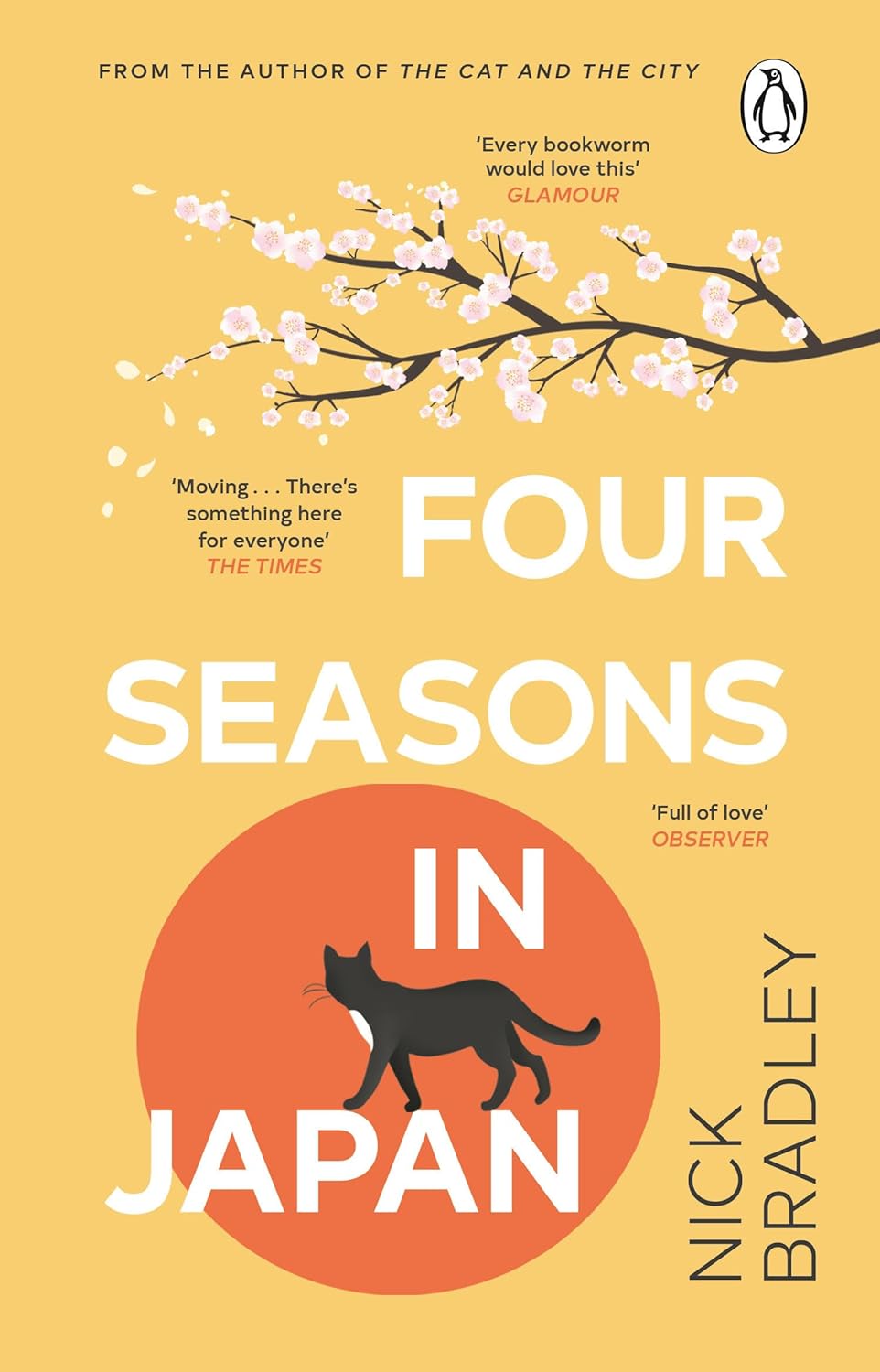
The structure of this book is an interesting way to tell a story. It is itself a book, obviously. And the first layer of its story is from the perspective of Flo, who is an American book translator living in Japan, who translates books from Japanese into English. And then we also see many chapters that are a part of the inner book she is translating, Sound of Water, which is a story of a boy, Kyo, who moves out to the Japanese countryside to live with his grandmother after he fails some exams.
Flo’s having a hard time with her relationship. Kyo is having a hard time with his life. The two are connected, and Flo’s story is partially about her connection to Kyo’s story. When we start talking about the author of Sound of Water, who’s an author in the middle layer - Flo’s perspective - who has based his book on personal experiences in his (fictional, to us, the reader) past, it’s all got a lot of layers.
But it doesn’t get caught up in any of that in an elaborate sense. It tells the story of its characters at the various layers and you can choose to just enjoy them for what they are. Flo is a remarkable self-sabotaging person, in a quiet way that makes you root for her (she can’t bring herself to ask for the help she needs) and it’s heartbreaking to see her internal dialogue that the other characters (understandably) never really grasp.
Kyo is similar, and it makes sense that Flo connects to him while reading his story, because he also can’t find the right way to reach out to people. (I don’t get the impression that she realizes this though.) He also makes some pretty dumb decisions, but you can see why he makes them, and he’s never malicious about it and often understands where he went wrong afterwards.
However, that does bring me to Ayako. Ayako is Kyo’s grandmother. Internally, you can see from her internal dialogue that she’s a warm and reasonable, if flawed, person. But externally, she is infuriating. Like Kyo, she makes a series of dumb decisions throughout the nested book. But the thing that sets me off about her decisions versus his is intent. She chooses these things intentionally, instead of doing things accidentally. And she insists. She wields the authority of her social station to paper over her mistakes.
Honestly, you can see that Ayako has a redemption arc. And there is a lot to like about her (and a lot of very good and powerful reasons why she acts like she does). I was ready for the redemption.
There’s another bit of a mystery towards the end, where Clearly that interpretation is left to the reader. So
Flo’s story is less ambiguous in its resolution.
There is some Japanese scattered throughout the book: in vocabulary for cultural terms, in several poems and old sayings that are embedded in the text, and in the chapter markers. この日本語は難しいけどよむのをがんばりました。このさいしょの話(フローさんと)は翻訳者のノートがあります。これはフローさんの翻訳者のノートですでもこれも著者から読者にメッセージです。だから面白いです。
It all comes together to make a deep and enjoyable story (or stories). A big risk is that one would be significantly more interesting than the other, and it would be a slog to get through the lesser of the two. But both shine for different reasons and I was glad to reach the varying resolutions for them.