Review: Out-Island Doctor, by Evans W. Cottman
by

Stuart Holland
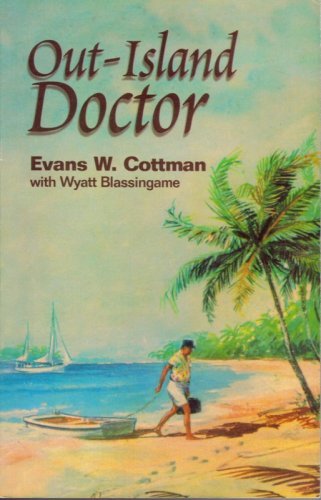
There is something special when you read a story about somewhere that you’re personally deeply connected to. As you go about your own life, it’s hard to know what parts of it are local to where you are. But then if you move, go somewhere else, you find some things missing, and realize that now they’re a part of you. Like when I read Bahama Tales, this book and its direct connection to the islands of the Bahamas is also a direct connection to me.
It hits you right away when you start reading. I don’t know if I’ve ever seen the Bahamian accent written down like it is here. People talk and I can hear them. There is a lady in the first chapter who, talking about a donkey, says “And today he dead”. It’s a simple sentence and in standardized English grammar is missing some words (at least an “is”). But that’s how she would’ve said it. Because there a correct way to pronounce that sentence like a Bahamian, and I heard it (even said it out loud) as soon as I read it written on the page.
The book’s tagline “De doctuh done reach” is another Bahamianism that immediately expresses its meaning (“The doctor has arrived”) and also a familiarity with the Bahamas you only get by knowing it yourself.
Cottman’s story is a fascinating one, back in WWII era Bahamas, which isn’t a time period I know much about (aside from that there were some airfields that were of relative importance there at the time). He’s driven by a wanderlust to seek out the islands. And he does a lot of good along the way. He’s not a doctor by American standards, but he has enough of a medical background and a willingness to learn that he becomes invaluable to remote communities that otherwise wouldn’t see a doctor for many years, if at all.
There are artifacts of the time in the writing. He refers to locals as “the natives” a few times, which isn’t a charitable way to phrase it today. But in the context, you can see that he cares about the people he treats. He’s in it for adventure, he’s driven intrinsically by wanting to see the remote places, but he also goes above and beyond what would’ve been necessary for just that. The continued medical training, the personal efforts to save individuals, the regret over those he can’t save. It draws a positive overall picture.
And I had of course forgotten until the radio broadcasts about the war appear in the story, at the time of writing the Bahamas was still a part of the British Empire (and would be for another few decades).
There are some difficult tales of loss in the story as well. The child Cottman and the other doctor fail to save. The tuberculosis victims living in destitution. The prevalence of poverty throughout is apparent, even in locales that have relative success.
I also noticed some odd typography errors in the printing of the book that I have. At first I just thought they were errors like you’d find in any printing. But later on I began to wonder if the printed word had actually been OCRed (optical character recognition) from a handwritten copy (I don’t know why that would’ve been done). Particularly when the character of Ol’ John had his name written as 01’ John (with a zero and a one). It doesn’t detract from the story, but it is an odd artifact that I would love to understand.
Still, it’s a remarkable story about how one person can choose to make a difference and the number of lives that can be touched in the process. If you’d like a glimpse into some of the less traveled Bahama islands, going there is the way to do so. But reading this book is a reasonable gesture towards it as well.