Review: Clair Obscur: Expedition 33, by Sandfall Interactive
by

Stuart Holland
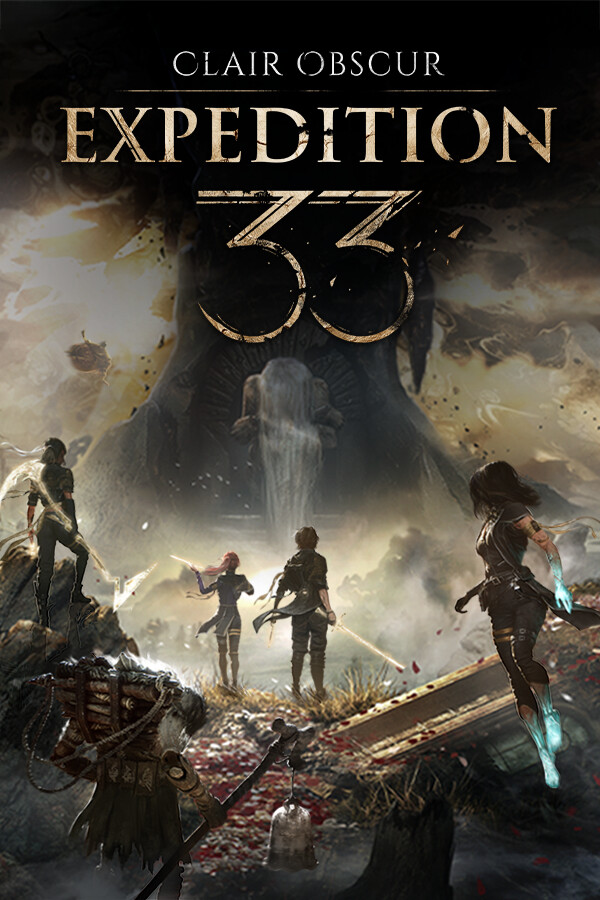
The game of the moment. Clair Obscur: Expedition 33 has been cleaning up at award shows in the latter parts of 2025 and into 2026. And holy shit, does it deserve it. This is my favorite game that I have played since Hades, and possibly even more than that (which would take it back to “favorite since Batman: Arkham City”, which I remind you, came out in 2011). There is everything to love about Clair Obscur, and I’m gonna run through as much of that as I can remember here. I’ll keep all story details spoilered.
And I am going to start, as you do, at the end. The non-spoiler version of this first thing, is that at the end of the game there is a choice. And, I kid you not, that choice remained on screen when I got to it for about 20 minutes. 20 minutes of me wrestling with the morality of it. 20 minutes of me trying to figure out which option I wanted to pick. Which option I should pick, and was that the same as the one I wanted? I sat paralyzed by that choice for so long because I cared so much about the characters that hung in the balance. About the world that had been built over the course of the game.
In the end, I did choose. And I researched the other paths afterwards as well. I can see why someone would choose any of the available ways. And yet, all of those people have weighty consequences to consider.
Let’s get to the meat of the ending then.
Ok, that was a lot about the ending. But I am indeed here to talk about the whole game. Clair Obscur, in addition to being a great story, is also a great game. Turn based RPGs aren’t the industry titans that they once were, but Clair Obscur was clearly made by folks who understand the appeal of those games and why they were so successful. They take a lot of the good from previous turn based RPGs (the influence of Final Fantasy is clear) and also layer on elements that enhance it.
The first is the parrying/dodging system. This can be a negative aspect for some players who struggle with the timing, but I do think Clair Obscur strikes a great balance here. I will note that I generally bounce off Soulslike games because I don’t enjoy the “getting good enough at parry timing to proceed” part of the process. Clair Obscur does a lot to sidestep that by separating the way it does parries and dodges. Both of them rely on the same timing windows during your enemy’s attacks, but the window for avoiding damage with a dodge is much longer than for a parry. The drawback to dodging is that you can only counterattack by parrying (and doing a bunch of extra damage), not by dodging. But the game is balanced in a way that that’s fine. I played through most of the game using only dodges. It was only later on that I realized I had become good enough at the dodge timing that I was already pretty good at the counter timing, and could build from there.
Another tiny, but essential thing they did with this is the difference between “perfect dodges” and just dodges. Mechanically in that fight they’re identical - if you dodge an attack (perfect or not) you just don’t take damage from it. What a “perfect dodge” is telling you, is that if you had parried that attack instead, then you would’ve got the parry timing right. This lets you practice without being committed to parrying everything with the smaller timing window. And if you see yourself perfect dodging a whole bunch of an enemy’s attacks, why not trying parrying them instead for bonus damage?
That skill progression means you can continue honing your skills while still making forward progress. You’re not stuck unable to progress the story just because you can’t do the timing perfectly. Not to mention, the difficulty options adjust the dodge/parry timing windows to be more forgiving (on lower difficulties) or more punishing (on higher difficulties). So you can tune that core part of the experience to your preference.
And of course, the dodging and the parrying serve a purpose. They make it so that the entire battle has something engaging for you to be doing. During your own turn, you’re strategizing about how to best use your own attacks and abilities. During your enemy’s turn, you’re watching like a hawk to dodge/parry their moves. If you didn’t have the opportunity to block enemy moves, then the enemy’s turns would essentially just be a constantly-repeating cinematic.
Strategizing on your own turn is also done very well in Clair Obscur. All of the different playable characters share a common structure about how battles work. The turn order, the basic attacks, the AP (action points), skills that do damage, gradient attacks that you build up over time, and dodges/parries. But each playable character also has their own set of strategic decisions to make that makes them play differently. You can brute force your way through, playing them all the same, but they really come alive when you start learning into each of their own mechanics. Maelle’s stances, Lune’s elemental stains, Sciel’s foretell cards, actually made me mix and match parties and compositions much more than I do in other similar RPGs. Each one feels unique but also similar enough that you’re working from a common baseline. They’re their own strategic minigame that prevents you from falling into a repetitive local maximum of damage. Instead, your best choice varies depending on the state of the battlefield and your own previous actions.
Over the course of the game, as you build up luminas (essentially “capacity to equip more abilities simultaneously”), you realize that entire new strategies become available to you. When you regain 5 AP per attack instead of 1, you can equip a very different set of skills that all have higher costs. When inflicting burns on your enemies also gives you more AP, boosts your damage, and makes you faster, then you can switch up your skills to inflict more burns per turn, per enemy. When one character can inflict “marked” reliably, you can exploit that with another. And all sorts of other options that suit your fancy.
It would be remiss of me to talk only about mechanics and not also mention that Clair Obscur is a beautiful game. Characters are expressive and the world is haunting. Regularly, I would transition into a new area and assume I was looking at a staged loading screen image, only to realize after a few seconds that it was playable. I was already loaded in, the characters were standing there waiting for me to move.
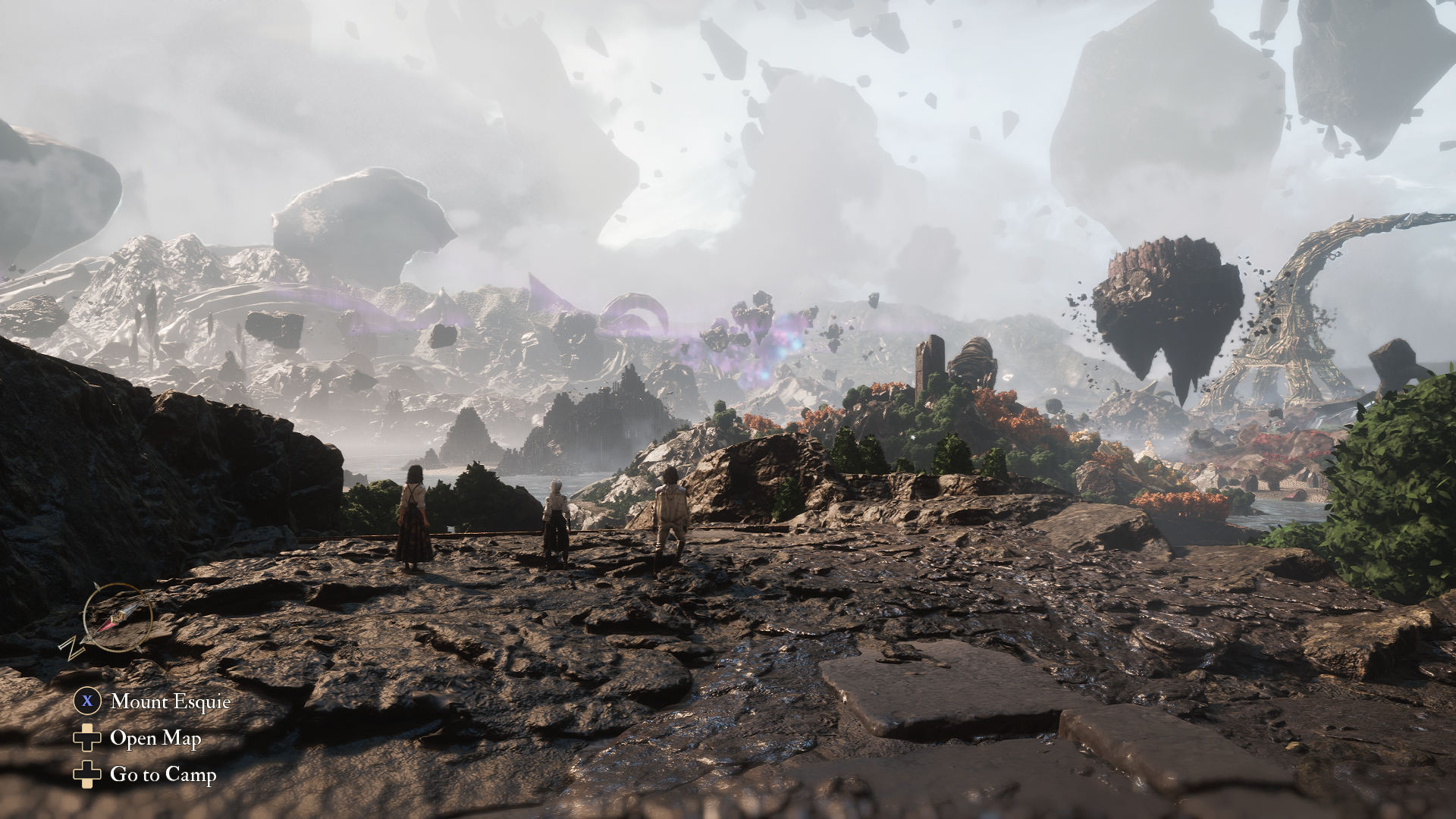
Look at that vista. The style of everything is also deeply connected to the story and the secrets you uncover throughout the game. As more was revealed, the artistic touches in all of the levels that made them look so bizarre and otherworldly all started to make sense.
And that brings me to an element that I’m very impressed with from a game development perspective. The connectedness of all of the different aspects of Clair Obscur goes so deep into each part. The world looks like it has been painted, all the brushstroke evocative effects that stream out of characters and locations. The absolute disregard for physics of the floating rock formations and distorted structures. The way all of these things fit into the story’s secrets means that those secrets were both decided upon early enough in development and communicated out across the team so that it could be incorporated into every part of the game’s development.
Did you notice that all of the music that is centered around Verso has a significant piano part in it? Seems like no coincidence that Verso likes to play the piano. Or that .
And here, I must stop, and I must talk about the music. Holy shit, the music. It’s incredible. First off, there’s so much of it. Go look up the soundtrack, it’s like 8 hours long. That’s insane! You can actually scroll through the soundtrack and follow the events of the game in it. “Here’s the track for the fight with the lampmaster.” “Here’s the one that plays when you talk to Maelle at camp.” “Here are the five tracks that play on the world map.” Quantity is impressive, but the quality also goes all the way. I’ve been listening to it on repeat while I’m not playing the game and just shuffling through the whole thing is a joy.
There are some killer individual tracks: “Lumière” is the first, the melancholy track that you’ll encounter early on. The title of the game (the “Clair Obscur” part) shows up prominently in it, and that serves as a great rallying call throughout the whole soundtrack. Other standouts include “Une va à t’aimer”, “Gestral Village - Golgra”, “We Lost”, and an alternate version of “Lumière” called… “Clair-Obscur”. And that notion of alternate versions of songs shows up a lot and is used to great effect. There are several different takes on the same song that are used at different places throughout the story. “Clair-Obscur” is a sadder, more acoustic version of “Lumière”, used to revisit the feelings it evoked when you heard it first, but now in a new circumstance. “Une via à peindre” is a hyped up version of “Une va à t’aimer” that’s used in a new, escalated situation within the story.
The degree to which every different part of the game is meshed with the other is incredibly impressive, and serves to make each of them better when seen alongside the other. And when we’re talking about audio, I’ll also talk about vocal performances. The whole cast does an incredible job, including some recognizable voices. Jennifer English, of Shadowheart in Baldur’s Gate 3 fame, as Maelle does a fantastic job. Charlie Cox (Daredevil) and Andy Serkis (Gollum) are also amazing as always. And those are the big names that I knew before, but everyone delivers great performances across the board. Maxence Cazorla as Esquie is particularly delightful in how bizarrely endearing he manages to be. Sometimes it sounds like he doesn’t know what the words he is saying mean. Often he’s nonsensical and barely connected to what’s happening, as beautific non-human immortals are wont to be. And then he slams an emotional hammer on you in the next sentence.
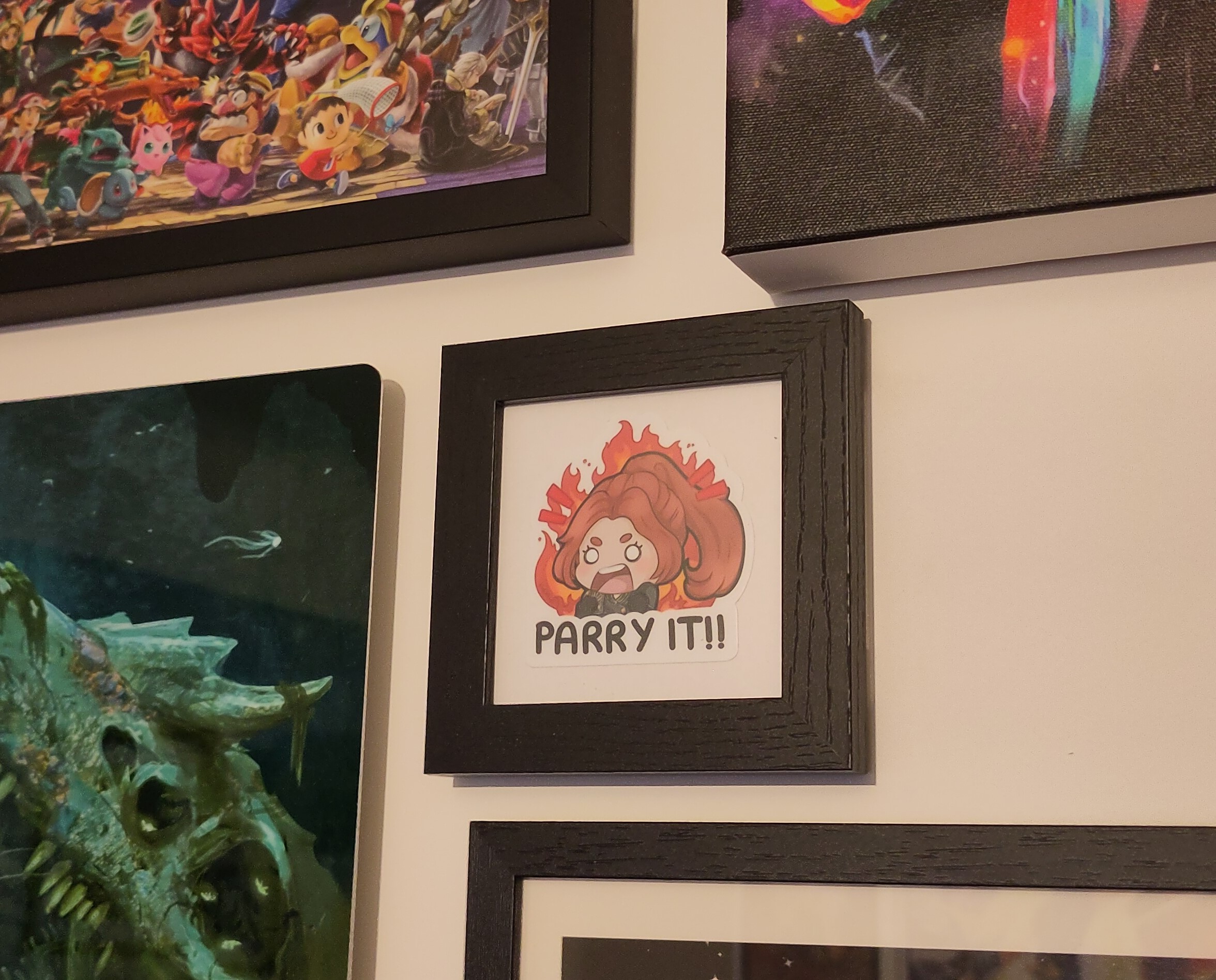
I’m also a big fan of “barks” that are done particularly well. A “bark” is where a character says something quick that is often repeated when some mechanic triggers in game. Some of these repeated lines of dialogue just tickle me and stick with me. I can’t quite place what makes the individual line work so well, but they’re always simple and it’s somewhere in the delivery. Clair Obscur has a wealth of them that stuck with me: “Parry it!” - Maelle, “For those who after” - Gustave, “Maximum damage” - Verso, “Some violence, yes?” - Monoco. For that first one, I even went and found someone else online who had enjoyed it so much and made some art of it for me to frame:
And that also plays into a big part of why Clair Obscur is both so fun and so moving. The above is clearly intended humorously. The mime enemies, and particularly the gestrals, all play off a significant amount of comic relief in a game that is also often about grief, loss, and death. Those two aspects of the game play off against each other incredibly well, breaking tension, but also allowing new tension to build. Some scenes break out of dourness with levity. Others are torn suddenly from moments of tenderness to desperate danger. Between it all, Clair Obscur keeps a sense of melancholy throughout that matches up very well with the tone of its story.
The gestrals are a great example of this. They’re clearly comic relief, though they do have several very serious emotional moments to them. And the way they are and how that works (or doesn’t) also has gravity to it. They play heavily into the cohesiveness of the whole game as well. The nevrons, as your most frequent enemy, are frightening, bizarre, and otherworldly. The gestrals provide a constrasting happiness and joy. But the way they want to fight everything in a “scrappy puppy” kind of fashion also means that the game can spend a lot of time with them without obviating its combat systems for the entire duration. And even more, the gestrals’ attitudes and actions fit incredibly well into the fiction of how their work.
Clair Obscur is a game that takes itself very seriously. But it also knows when not to. It does that internally with the gestrals and to a lesser extent the mimes. But it also knows when not to take itself seriously with the player. The collectible for Expedition 60 is a hilarious little jaunt of levity. But on top of that, have I mentioned… baguette?
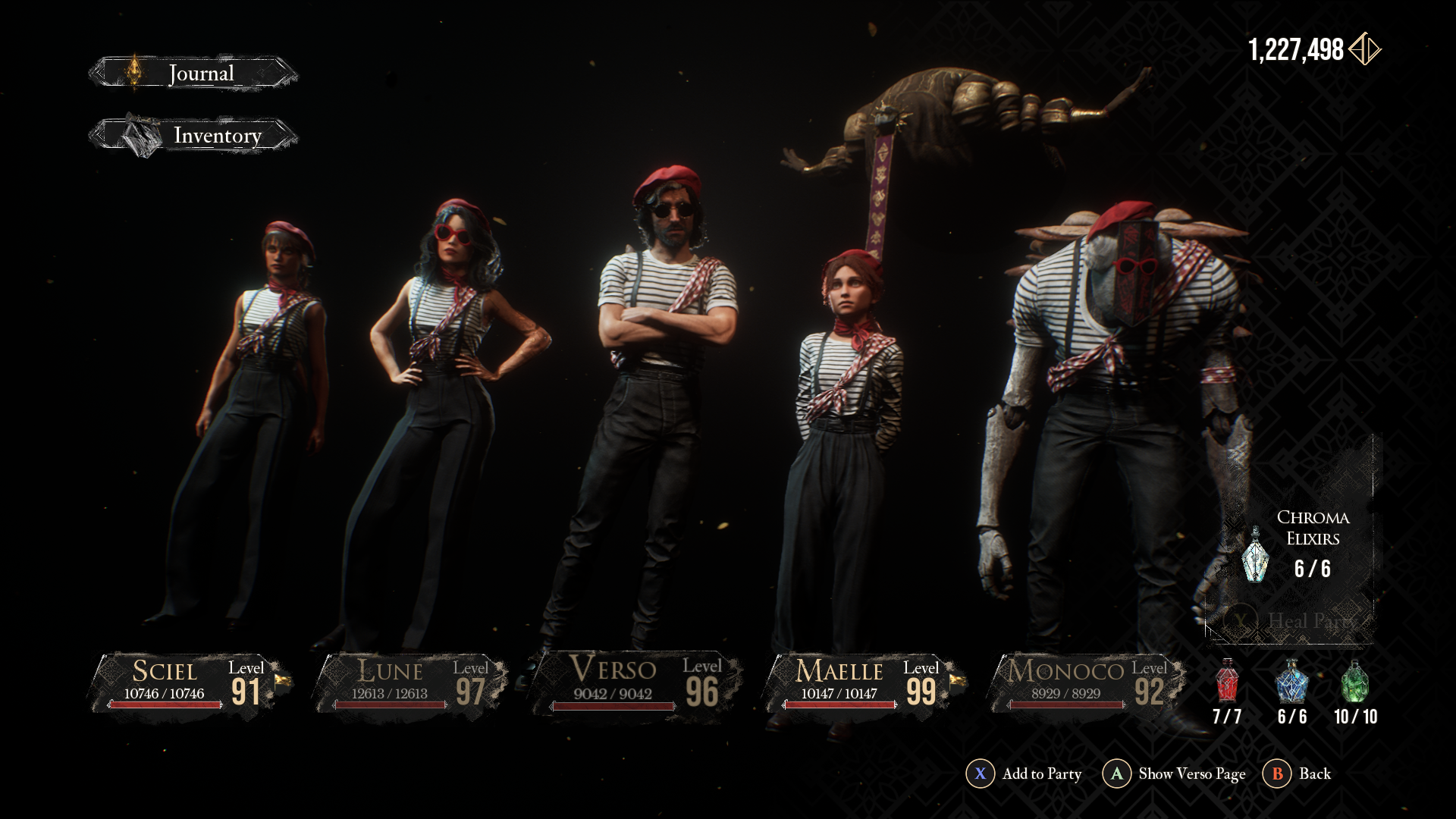
The folks who made those costumes were having a lot of fun.
And that brings me to another thing that holds a lot of Clair Obscur together. It’s very French. It picked a motif/inspiration/aesthetic/culture and committed to it. From the twisted Eiffel Tower in Lumière, to the occasional “putain” in the script, all the way to the above exaggerated stereotype, that Frenchness permeates every part of the game and makes it richer for it.
Ah. And richness does bring me back to story. I spent a huge spoiler chunk earlier in this post talking about the ending. But I also can’t not talk about the end of Act 2 and
It’s all a remarkably well executed story, holding together an incredibly well executed game.
I’ve written a lot of words gushing about how great Clair Obscur is, but that isn’t to say it doesn’t have any flaws. Generally though, I think these flaws mostly represent good development decisions on Sandfall’s part. Fixing some of these would likely involve a lot of work and honestly it would be for minimal payoff. But still, there were some things that I thought worth discussing.
Lip syncing. This was my biggest problem and it’s the thing that I think did actually detract from the experience. Characters’ dialogue was frequently desynced from the movement of their lips and particularly during emotionally heavy moments, this was incredibly distracting. If I think any of the flaws I list here are worth fixing, it’s this one.
The next is that when controlling your character, up to two of the others in your party follow you around. Those following characters clearly don’t navigate with the same restrictions as the player. They get stuck on little rocks and teleport around frequently to keep up with you. A small number of the teleports are disconcerting because they appear in bizarre places that detracts from a scene. But 99% of the time this absolutely does not matter and is a perfectly reasonable corner to cut.
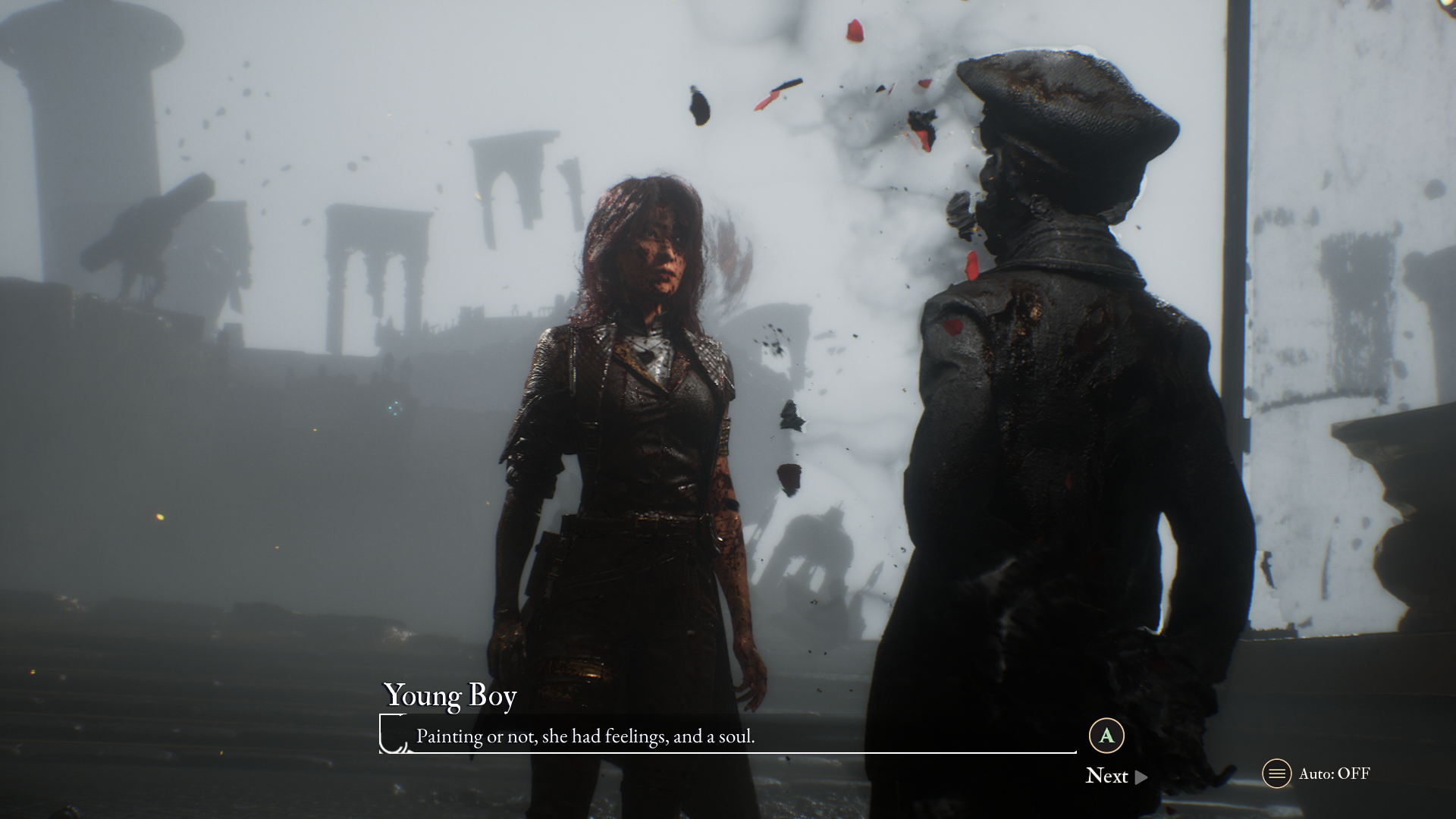
Another one that affects the emotional weight of the story is that sometimes the characters can look strangely emotionless and doll-like. You can see this in the first image in this review actually! Look carefully at Lune’s face. It’s less obvious in that one because it’s not a close up, but it happened during some cinematics that were much more obvious. And once I noticed it, I started seeing it more often. My guess at the pattern of it is that the character’s facial animations are tied to their lines in the vocal performances, and when transitioning between separate scenes/lines, there is no facial animation to use, so they revert to a default expressionless state. It is a bit spooky looking, and maybe it’s a commentary on them not being real, but to me it looked more like an error. Also a reasonable corner to cut though, as this review can show you I still connected emotionally to the material.
Next up: the campfire cinematics. Particularly the ones where most of the content is expressed through dialogue boxes. Compared to all of the other cinematics, these felt stilted and forced. It’s amazing how much impact the pause between dialogue box transitions can have in disrupting the flow of how the characters talk.
And finally, the range on the fucking RB attack you use to start a battle. The visuals and the hit box for this seem to be incongruous to me. For the entire game I was constantly confused about how close I had to get to an enemy to be in range (and also at what range a non-initiated-by-me battle would start). The VFX associated with the attack goes way farther than the actual hits do, which is distressing when you don’t have time to do it again before the enemy reaches you, and you forfeit that combat advantage. This is a small thing, but also a constant annoyance.
There is probably a criticism to level against the character movement, but I don’t think it’s a super worthwhile one. Generally you can accurately and easily control your character on the map and get to where you’re intending to. The platforming mini-games all worked better than I expected them to (even the climbing one), showing me I had more precise control than I thought I did. And it’s important that this isn’t the primary focus of the game - it’s not a platformer and doesn’t try to be. Limitations here are very reasonable and didn’t get in the way of the experience.
And when I talk about the climbing mini-game, that brings me around to another topic I haven’t covered: bonus content. There is the primary path through the story and the main mechanics that make up the meat of the adventure. But Clair Obscur also has a lot of fun and interesting side content. I don’t just mean the items down the “other path” in every area.
It was impressive how every mechanic in the game had some kind of dedicated side mission. The gestral mini-games were a lot of those and while they took a little time to get the knack for, they were never too punishing. (Did you know you can sprint during Gestral Volleyball? That took it from extremely difficult to “I beat this first try” for me.) Even the “climb up the anchors” mechanic got a mini-game.
But it’s not just mini-games. Clair Obscur steps into the shoes of RPG classics in another way: optional bosses. These don’t obstruct your progress on the story, but offer greater rewards and challenges to players who want to take them on. The chromatic versions of various nevrons play with the dodge/parry timing and even the mechanics themselves (forcing you to adapt accordingly), leading you to master that part of the game better.
The optional bosses are also great skill challenges for players who want to push themselves beyond what they need for the main story. And they show you how Sandfall challenges you on the main story, but they are pulling their punches. The optional bosses really set out to show you how much more challenge there could be, and how much room there was to play with the game’s mechanics further. And at the end of it all, I’m of course talking about one specific boss. Simon.
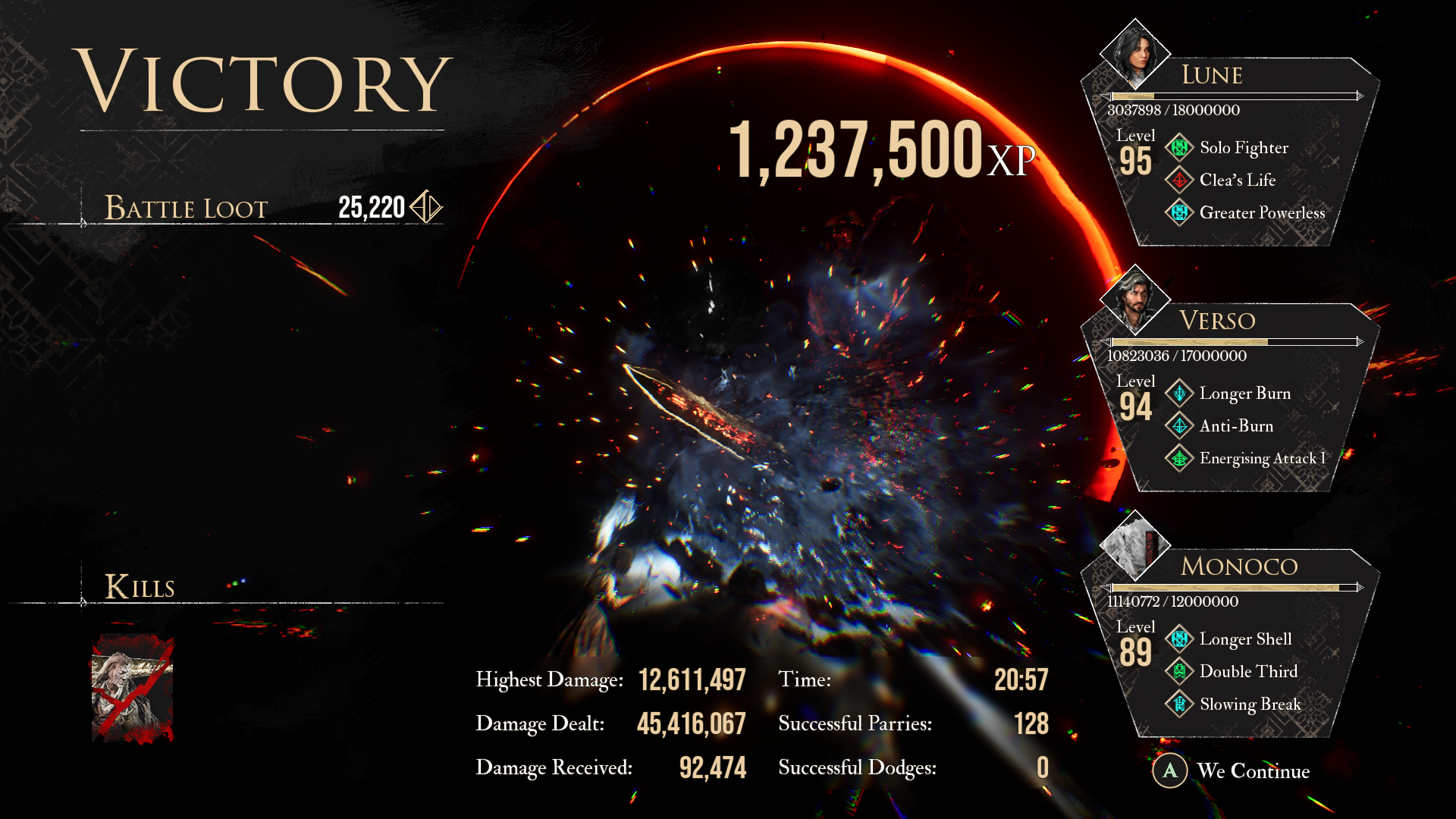
It was an incredible capstone to an experience that I thoroughly enjoyed. My favorite game in a very long time, as I said earlier on.
But that also isn’t quite the end. In December 2025, Clair Obscur got an update. I only started playing Clair Obscur at the end of December, so this all came as part of one package for me. That update added a new area. Verso’s drafts is a fantastic sendoff and a great microcosm of why the rest of the game was great.
And a final thing that I very much enjoyed was that I saw so much of myself in Lune. The way that whenever something new or unexplained happens, she jumps to trying to understand it. She asked so many of the questions that I always want characters to ask when confronted with the unknown and I could see how much she wanted to use those answers to box in the possibilities until she worked out the truth. She didn’t get a lot of the answers she was looking for, but she found out a lot more than most did. It was a joy to watch her learn.
And with that, if it isn’t already clear from the amount I’ve written here: Clair Obscur: Expedition 33 is fantastic. A real tour de force of video gaming excellence. Masterfully executed in how it keeps all of its separate parts pulling toward the same story and gameplay goals. And a great exemplar of games as art. I am bereft now, because it is over, and I am changed because I have played it.
You should play it too.
Thanks, Sandfall Interactive. We continue. For those who come after.
Clair Obscur: Expedition 33
